Search results for tag #unix
![[?]](https://media.bsd.cafe/bsdmmedia01/accounts/avatars/117/230/143/862/280/275/original/12da6ab1e99ca926.jpg)
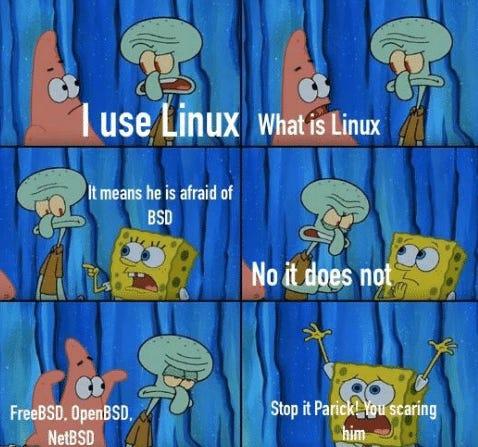
When you say ‘I use Linux’ and accidentally summon the entire BSD family.
#FreeBSD #OpenBSD #NetBSD #Unix #Linux #BSD #Meme #Memes #Humor #SpongeBob
Alt...
Six-panel cartoon featuring SpongeBob, Patrick, and Squidward. Patrick says, “I use Linux.” Squidward asks, “What is Linux?” SpongeBob replies, “It means he is afraid of BSD.” Squidward responds, “No it does not.” The next panel lists “FreeBSD, OpenBSD, NetBSD,” while Patrick looks funny. In the final panel, SpongeBob raises his hands in panic and says, “Stop it Patrick! You’re scaring him.”
![[?]](https://assets.oldbytes.space/assets.oldbytes.space/accounts/avatars/110/420/529/306/906/445/original/355236cce12249af.png)
#SCO #UNIX has been consigned to the dustbin of history by #retrocomputing folks, hasn't it? I never read about it here.
It was the first UNIX I ever interacted with. At one stage SCO did a special deal on SCO OpenServer 5. For the price of the media (Wikipedia says USD18), you got a boot disk and CD and AFAIR a slim manual. I picked it up, but back then I only had one computer (crazy, I know) and as far as I remember I never installed it on my hardware.
I tossed the media in disgust sometime during the SCO Group's years-long legal battles against Linux vendors. By that stage I was using Solaris on the regular and they had builds for x86 too.
![[?]](https://media.bsd.cafe/bsdmmedia01/accounts/avatars/117/191/574/632/588/453/original/4ec8f712d0f74296.jpeg)
![[?]](https://social.heise.de/__virtual/accounts/avatars/112/881/119/160/228/266/original/baf7ad72ec92f728.jpg)
NetBSD 10.2 patches some security vulnerabilities
NetBSD was recently released as point release 10.2. The developers are closing some security vulnerabilities.
![[?]](https://social.heise.de/__virtual/accounts/avatars/109/716/897/046/687/069/original/3e4fb0c2076b5f24.png)
NetBSD 10.2 stopft einige Sicherheitslücken
NetBSD ist jüngst als Point-Release 10.2 erschienen. Die Entwickler schließen damit einige Sicherheitslücken.
![[?]](https://s3.eu-central-2.wasabisys.com/mastodonworld/accounts/avatars/109/342/381/962/819/209/original/bf6cd6a1312a64f2.png)
I love the nerdy nostalgia of this: https://www.theregister.com/software/2026/09/22/commodores-forgotten-amiga-unix-gets-a-modern-revival/5297805
![[?]](https://cdn.discuss.systems/accounts/avatars/115/918/347/060/720/003/original/caf1f9d7ce449c5a.jpg)
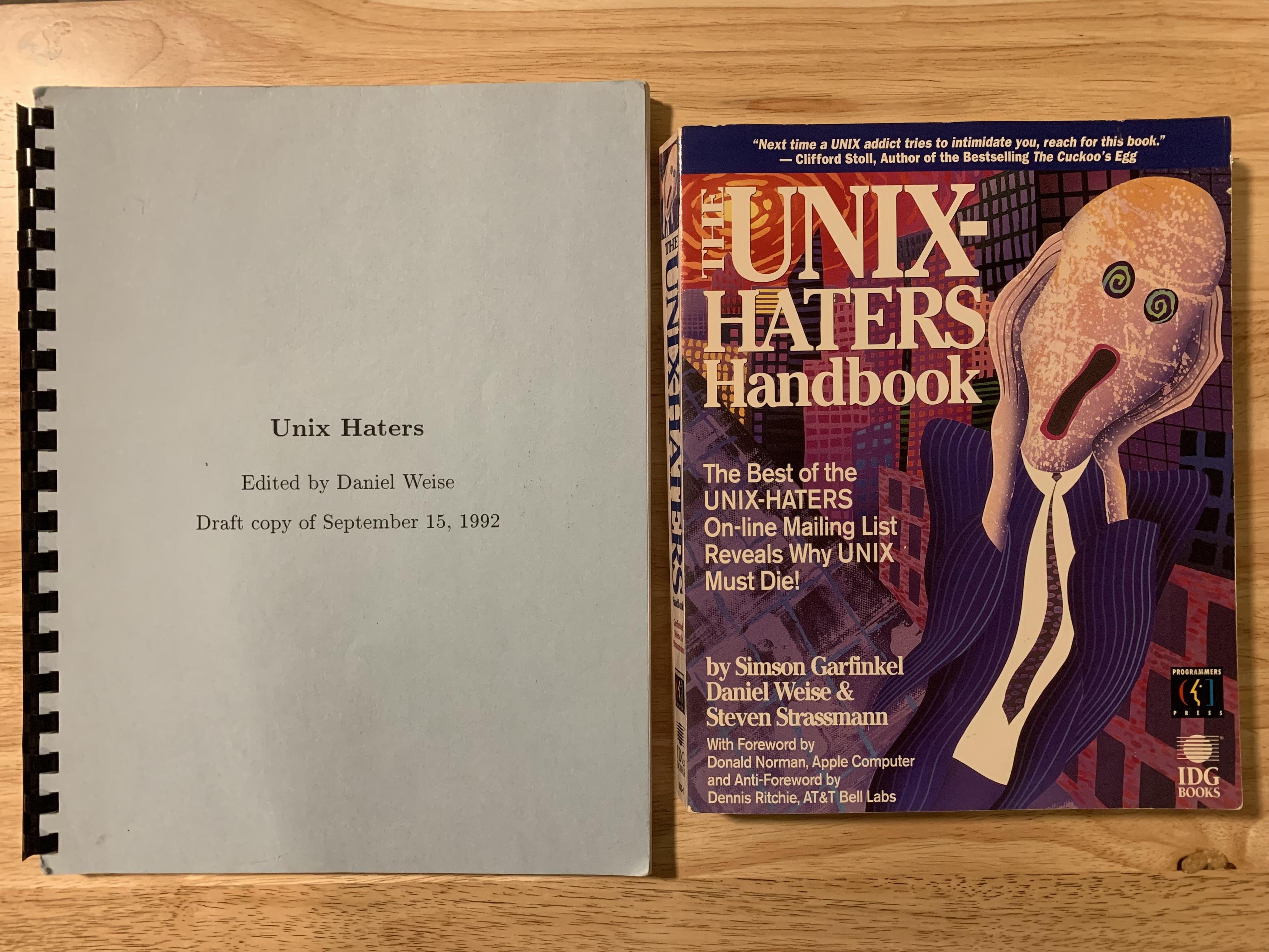
I hate UNIX.
#unix #vintagecomputing #retrocomputing
Alt...
Unix Haters, Edited by Daniel Weise, Draft copy of September 15, 1992
The UNIX-HATERS Handbook, by Simson Garfinkel, Daniel Weise, & Steven Strassmann, First Printing, May, 1994
![[?]](https://s3.c.im/accounts/avatars/117/270/926/559/588/907/original/32fd4e78dbf04d18.png)
![[?]](https://media.ominous.net/accounts/avatars/115/375/274/384/441/534/original/ebd7c6de7c700c83.png)
Not surprised to spot an SGI Personal Iris 4D at the MIT flea today.
CC: @flexion
#SGI #UNIX #MIT #FleaAtMIT #MITFlea #MitSwapfest #CambridgeMA

Alt...
A black Silicon Graphics Personal Iris computer tower with a computer on top, situated on a carpeted floor with fallen leaves nearby.

Alt...
A black vertical server storage unit with "Silicon Graphics" logo and "Personal Iris 4D/35" label, topped with electronic devices, in a parking area.

Alt...
Close-up of a vintage Silicon Graphics Personal Iris computer label with model and serial numbers, power input, and certification marks.

Alt...
A close-up of a black electronic device with "Silicon Graphics" and "Personal Iris 4D/35" written on it, with other equipment visible in the background.
![[?]](https://autistics-life.s3.bhs.io.cloud.ovh.net/accounts/avatars/113/069/752/021/752/470/original/d8009d9b7db3151a.webp)
![[?]](https://virmasto.hel1.your-objectstorage.com/accounts/avatars/117/120/275/729/476/066/original/e6de02d8a4828ad4.png?1789730208)
Most software treats features as the only metric for success. OpenBSD is a rare example of valuing correctness over bloat. It is a reminder that stripping away the noise is actually a feature. Fewer lines of code means a smaller attack surface.
Alt...
openbsd the value of a project that prioritizes security and correctness over feature bloat
![[?]](https://files.sueden.social/accounts/avatars/109/258/907/365/721/153/original/fcde6a2abf70342d.png)
NextBSD and the Gershwin desktop running in a UTM virtual machine on Apple Silicon/Arm64!
x86-64 and Raspberry Pi 500+ (and possibly other Raspberry Pi 5, currently being tested) systems are also supported.
#NextBSD #FreeBSD #unix #macOS

Alt...
A screenshot of the Gershwin desktop running on NextBSD which looks not quite dissimilar to older OS X versions...
![[?]](https://media.bsd.cafe/bsdmmedia01/accounts/avatars/110/901/147/484/217/272/original/42dd588e37bcd14e.png)
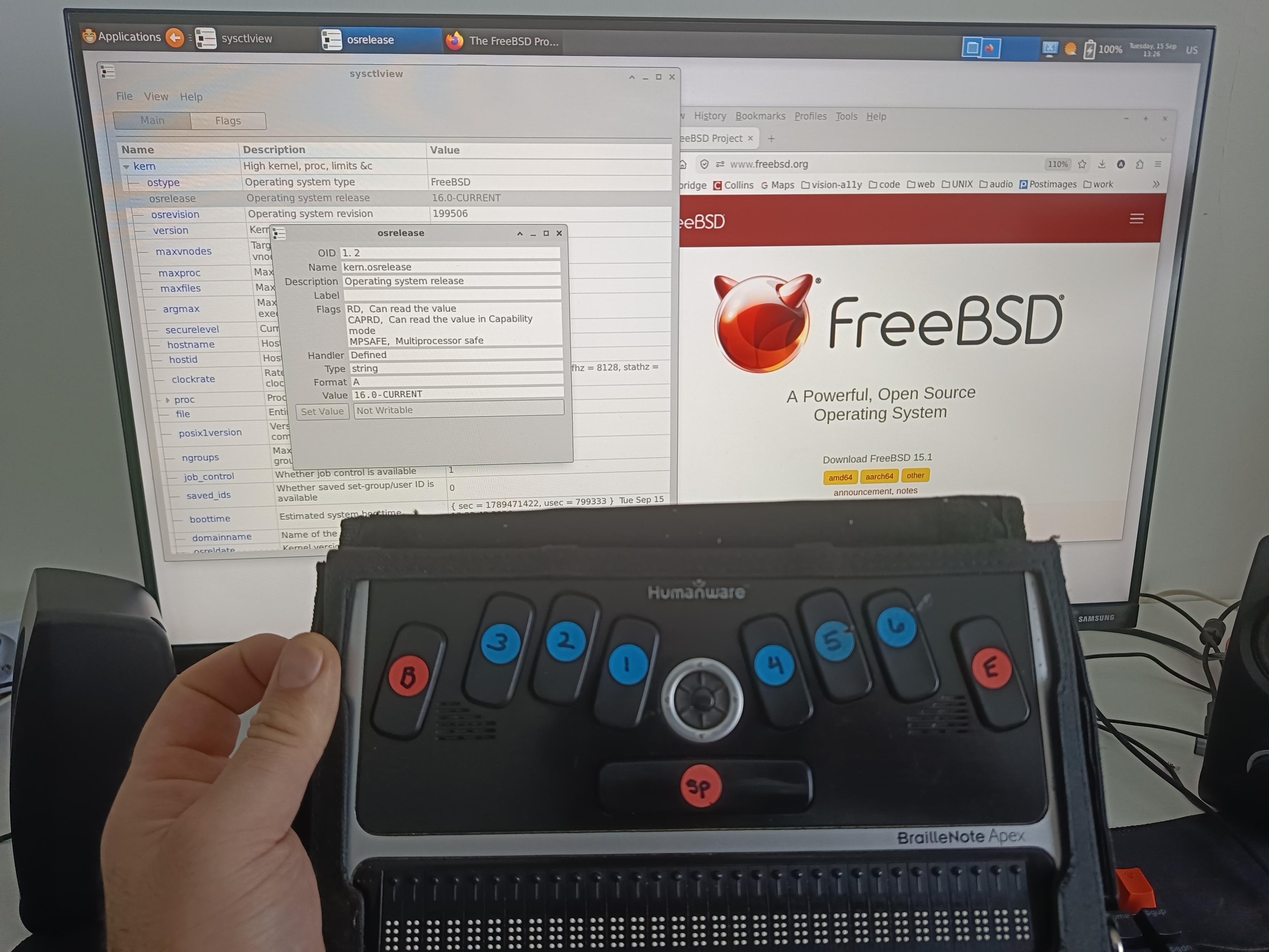
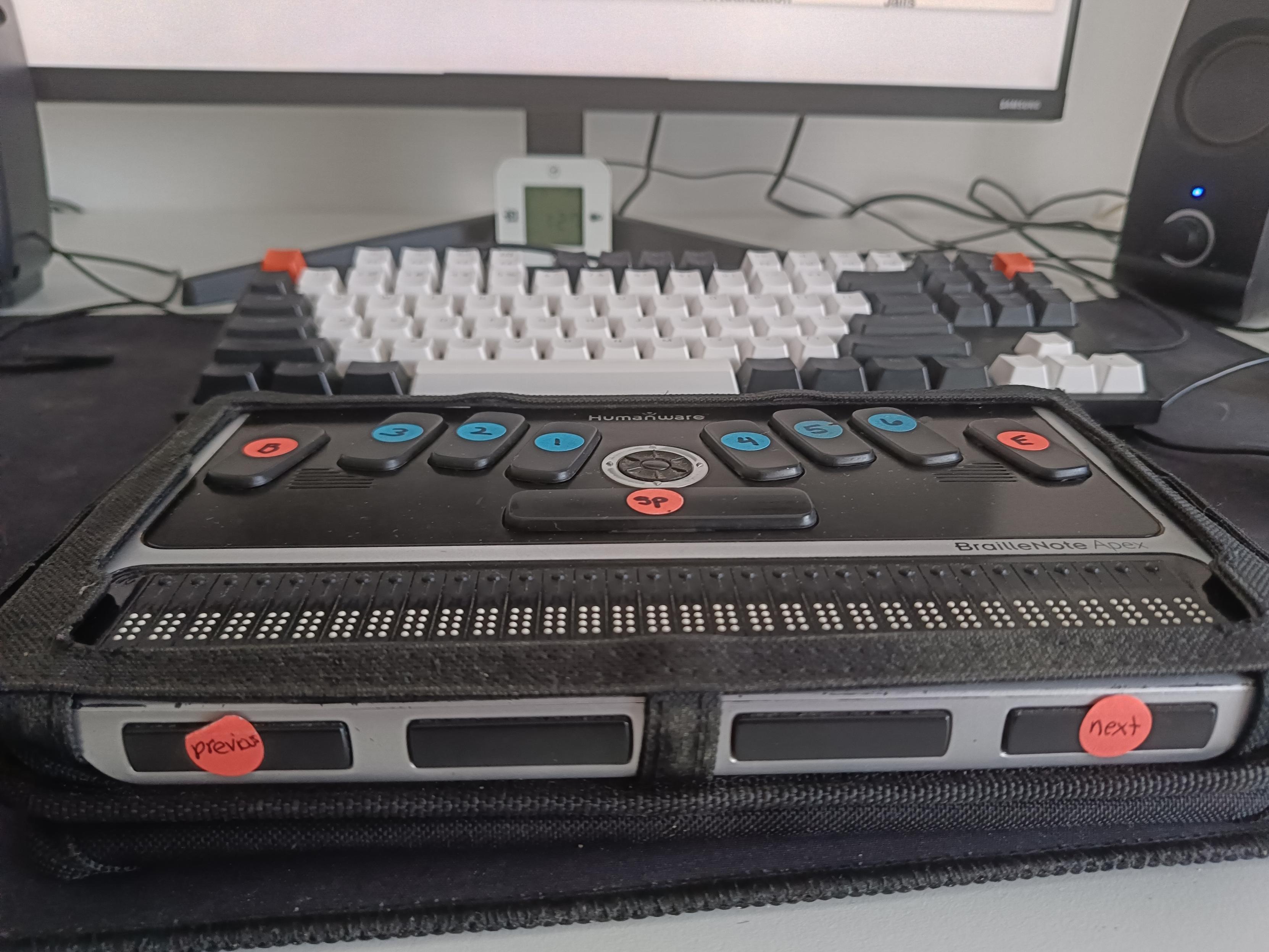
Finally, this Braille display has arrived from the United States!
The goal is to get it working with #FreeBSD and, eventually, provide a proper subsystem for Braille display devices on FreeBSD.
Another small step toward making FreeBSD more accessible. Learn more about the FreeBSD Foundation's Vision #Accessibility project: https://freebsdfoundation.org/project/vision-accessibility-subsystem-for-freebsd/
#Accessibility #a11y #FreeBSD #Unix #OpenSource #AssistiveTechnologies #Blindness #LowVision #Kernel #DeviceDriver
Alt...
The HumanWare BrailleNote Apex photographed from above, with a monitor showing FreeBSD in the background.
Alt...
The HumanWare BrailleNote Apex photographed from the front, showing the Next and Previous buttons, with a monitor showing FreeBSD in the background.
![[?]](https://media.infosec.exchange/infosec.exchange/accounts/avatars/115/266/371/041/931/793/original/21820b8f1d55ac2a.png) HackMag — Top-notch cybersecurity magazine » 🤖 🌐
HackMag — Top-notch cybersecurity magazine » 🤖 🌐
@hackmag@infosec.exchange
⚪️ Getting Started with Radare2: An Open-Source Framework for Linux Application Analysis
🗨️ If you have never used Radare2, you have probably at least heard of it: it is an open-source toolkit for program analysis and reverse engineering. It includes a powerful disassembler and debugger that lets you dive deeper into a system than standard GDB.
In this article, we will take an in-depth…
HackMag — Top-notch cybersecurity magazine » 🤖 🌐
@hackmag@infosec.exchange
⚪️ How to Set Up Parental Controls on Linux for Kids
🗨️ If you have children, you know that nowadays the usual list of parenting duties inevitably includes one more: pulling your kid away from the endless whirlpool of video games and TikTok and getting them to study.
Standard parental-control software is often ineffective, so we’ll tackle the problem…