Search results for tag #permacomputing
![[?]](https://media.infosec.exchange/infosec.exchange/accounts/avatars/109/292/293/714/620/731/original/566be7f542be4c0d.jpeg)
Observations on dailying a new to me Razer Stealth laptop:
- The level of jank in this #fedora 44 #kde installation went way up when I tried getting the fancy RGB keyboard stuff working via #OpenRazer. #OpenRGB doesn't have the flashier, uh, flashing, but my keyboard works more reliably and I don't have errors spamming my
dmesg. - The amount of Windows I had to deal with to get firmware updates run sucked. Worse, that never fixed some of the "this update is only for Razer" gates. Thankfully, unzipping the installer revealed the actual flash tools and scripts, and I enjoy living dangerously.
mokutil --pkreports #pkfail even after updates- The battery health reports 100%, and has been as high as 110%. Even if I don't trust that number, it is medium acceptable and pretty good for a ten-year-old computer. I can get a new battery from iFixit for $70.
- Gaming company customer support broadly sucks. If I'd bought this new, I don't think I'd want support for my $1500 laptop to have to pass through the lower-tier gates designed to ward off the "why did you ban me from online for doing nazi stuff?" support tickets.
- I can't tell if the webcam is broken or just picky about how its invoked yet. At higher resolution it puts out garbage sometimes, though it seemed happy-ish in Windows. Gets better with very low resolutions.
I'm happy with it, but I'm not sure I'd enthusiastically recommend. It's really, really snappy, but it feels like it could have used another round of updates from Razer before giving up on it as vintage. Nice product, not enough polish.
#razer #razerbladestealth #linux maybe #permacomputing since this is so old?
![[?]](https://files.functional.cafe/accounts/avatars/110/120/034/502/128/835/original/179ee313a5fd1d37.png)
As you may know I have been working for a while on a content-addressed language that I call Möbius (https://github.com/amirouche/mobius). Then, I dabbled, and I am proud to say I cracked the aphorism about John Shutt's Kernel, the one that goes "Kernel is impractical to compile". It is practical to compile when reified environments are immutable: https://github.com/amirouche/seed. Also, I have been working on the letloop distribution (https://github.com/amirouche/letloop) for Chez Scheme (https://github.com/cisco/chezscheme). Also, I dabbled with a new search engine (more about that another time).
I also have been writing a lot about Möbius, with good reason: it is exciting to hold so much in such a small substrate. I think I used to sell that too much, with too much grandiose machination, even if backed by code: no users yet. A lot of what Möbius promises is halfway delivered in bb.py (https://github.com/amirouche/bb.py) and bb.scm (https://github.com/amirouche/bb.scm). Most already exists in the wild by way of #scheme, #unison, #nixos and #softwareheritage.
It matters to underline: that line of work is neither new, nor disruptive, nor bullet-proof.
My goal was, and still is, to promote that sphere, and I am happy to share that the bus factor is honest.
Also, I don't want to let the idea spread that it is collapse-proof, unlike what #collapseos #duskos #permacomputing people try to achieve.
My goal is to fix the ship while flying it.
Tho Möbius, which will eventually be folded into #letloop, will not turn dirt into fresh water, or the fog into... a naziproof naziproof continuation that can be handed to the next generation...
That's why I poked holes in what you may have read in the previous articles, in a new essay entitled: What the hash cannot prove => https://hyper.dev/2026/mobius-what-the-hash-cannot-prove/#essay
Möbius is neither new, nor disruptive, nor bullet-proof. Most of it already exists in the wild via scheme, unison, nix, software heritage. Half of what it promises is delivered in bb.py and bb.scm; no users yet; the bus factor is honest. And it is not collapse-proof — that is #collapseos #duskos #permacomputing territory, not mine. My goal is to fix the ship while flying it.
![[?]](https://media.infosec.exchange/infosec.exchange/accounts/avatars/000/023/504/original/69cd9b6e12c637fc.jpg)
The build script for writerdeckOS v2.0 can be found here: https://github.com/tinkersec/writerdeckOS
While I am no longer supporting this project (I can't address bug issues or help with installation any longer), folks are welcome to use the code as is or fork it and run with the project.
If anyone wants to build out version 2.0 and create installation media for it, they are welcome to do so.
Cheers. It was fun working on this project and I deeply deeply deeply regret having to drop it. I just hit a wall with trying to get a better installation media and I don't have time to actively work on this project and keep up my other food projects.
I hope y'all have a great day.
![[?]](https://soundhunte.rs/@/k60/s/aa3dcd506bb2a1cfe561b275ec2ba135.jpg)
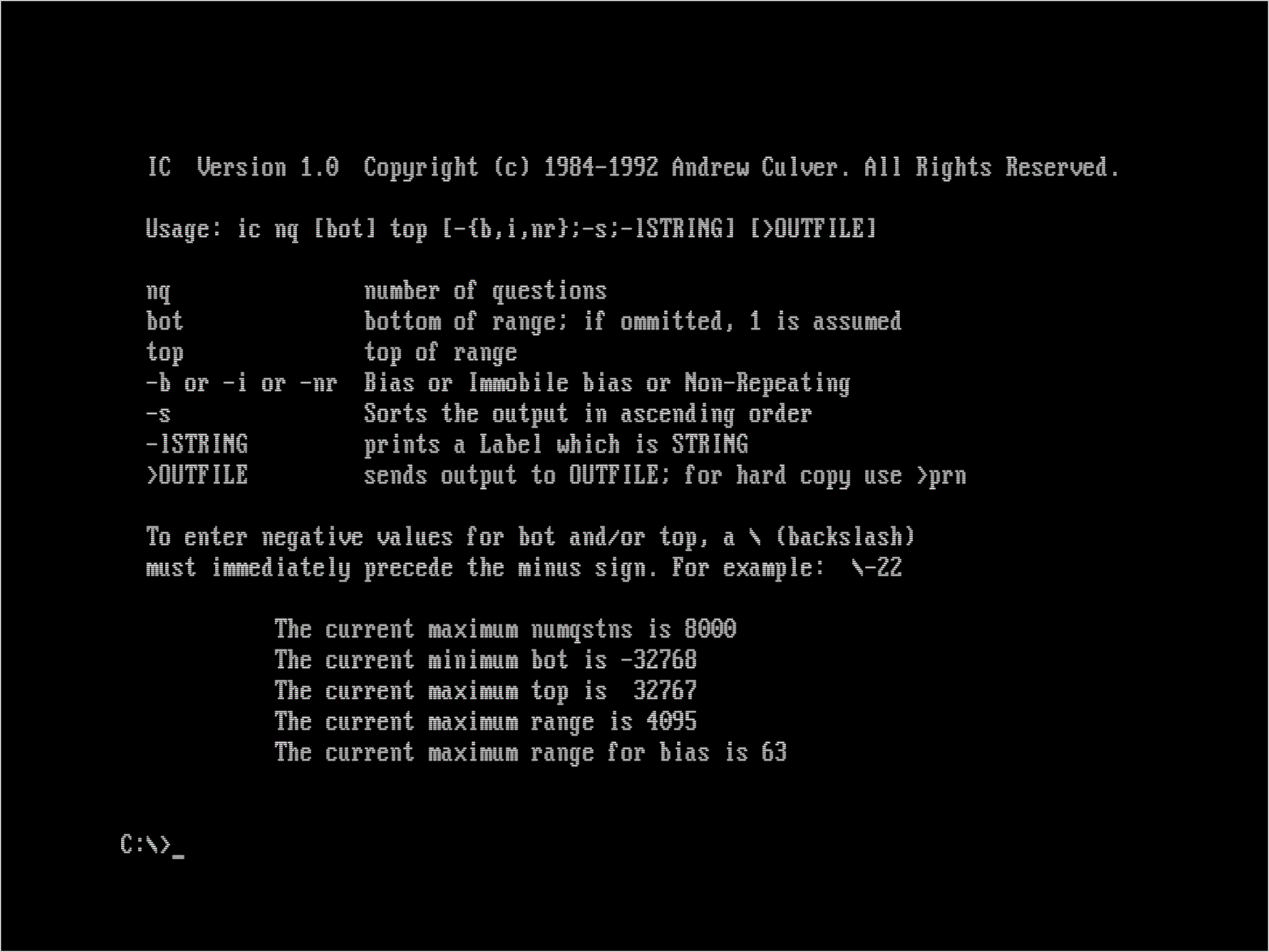
See: https://anarchicharmony.org/People/Culver/CagePrograms.html
(On the contrary, when I think about reviving my school projects from around 7–10 years ago—node.js and all that—my head hurts.)